The AI That Aced the Medical Exam, and Still Isn't Safe at 2 a.m.
Health AI is already in your clinic and your phone. The seatbelts are still being fitted.
Disclosure: I work in the diagnostics sector. The views here are my own, not those of any organisation I work with, and no organisation is named or described in this article.
Five numbers before you ask a chatbot about your health
#1: where one leading patient-safety non-profit ranks misuse of AI chatbots among its 2026 health-technology hazards.
94.9% vs. under 35%: chatbots named the right condition almost every time when tested alone, but people using them did so in fewer than 35% of cases.
2 in 3: sepsis cases a widely used hospital alarm missed in independent testing.
94.4%: hidden-instruction attacks that worked on a medical AI in a controlled simulation.
4 of 50: European countries that have set liability standards for health AI, according to WHO Europe.
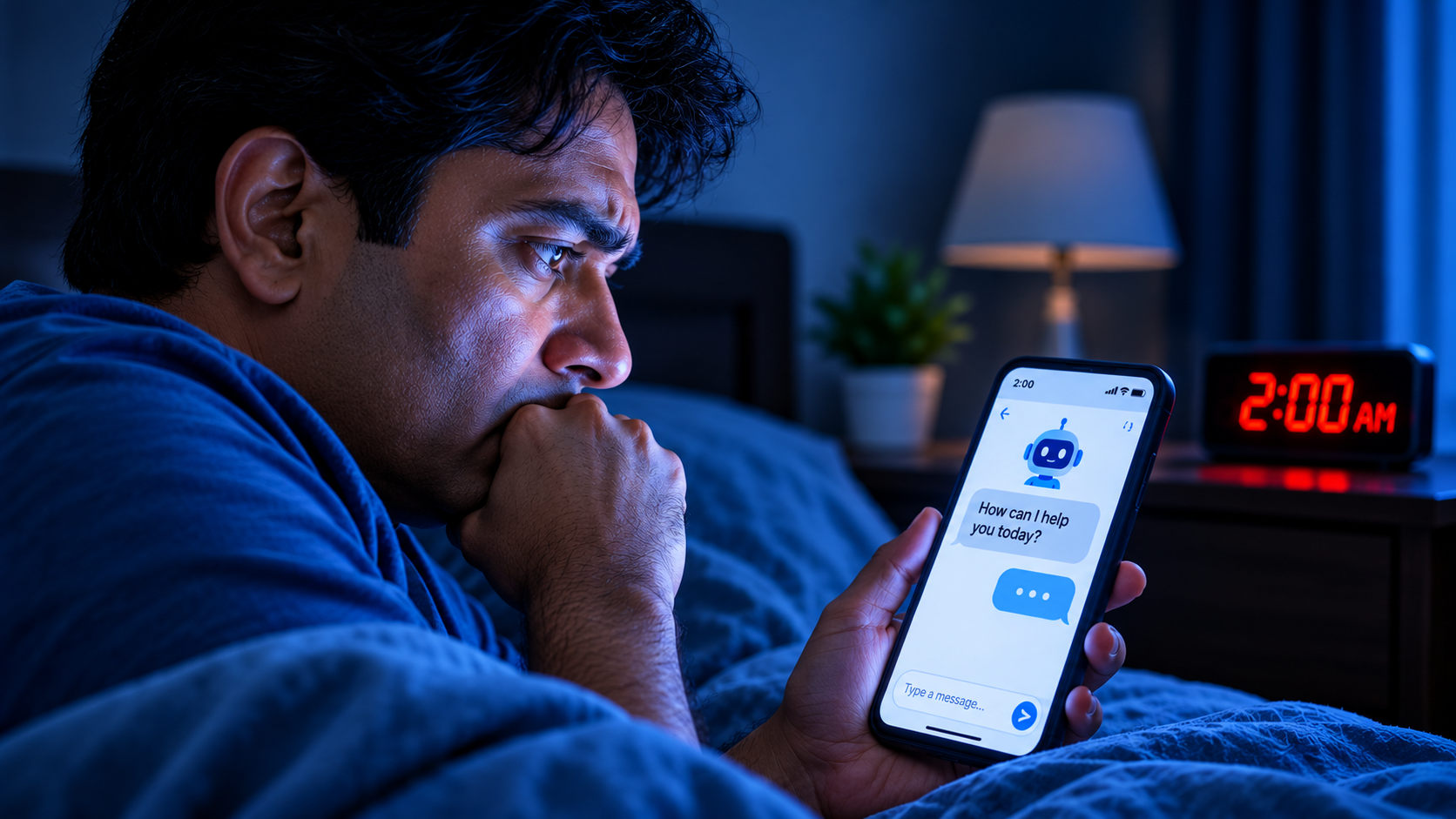
It's 2 a.m. Who do you ask?
Your father's chest feels tight, or your child's fever won't drop. You reach for your phone. Do you call a doctor, or ask a chatbot?
Millions now do the second thing first. In every city and every village: the same instinct.
I have spent over two decades in IT, much of it close to hospitals and diagnostics, and one rule has never failed me:
A system isn't tested when everything goes right. It is tested at 2 a.m., when someone is scared and nobody is checking.
This is not an anti-AI article. AI already reads scans, sorts emergency queues and saves doctors hours of paperwork. It is about the one thing that decides whether AI is a miracle or a menace: the guardrails. I read the reports that rarely reach front pages (regulator surveys, recall studies, hacking experiments) so you can see what the press releases skip.
THEN: confident machines, zero checking
Illustrative scene: a hospital boardroom, 2017. A glossy slide says the software "learned from the world's best cancer doctors." Nobody asks the boring question: learned from whom, exactly?
Three documented stories show the pattern.
1. The supercomputer trained on pretend patients (2017-18). Internal IBM slides, reported by STAT News, showed Watson for Oncology had produced "unsafe and incorrect" treatment suggestions. It had been trained largely on a small set of synthetic, hypothetical cases rather than real patient records. One example: a lung-cancer patient with severe bleeding was advised a drug carrying a warning against exactly that. Memorial Sloan Kettering said this was a test case and no patient was harmed. The lesson stands: the pitch said real patients, the engine ran on make-believe. [1]
2. The algorithm that mistook spending for sickness (2019). A risk-scoring tool of a kind used to manage care for roughly 200 million people a year in the US decided who got extra help. Researchers found that Black patients at the same risk score were sicker than white patients. The tool used money spent on care as a stand-in for how sick you are, and less was spent on Black patients with the same illnesses. Correcting it would have raised the share of Black patients flagged for extra care from 17.7% to 46.5%. [2] Nobody wrote a racist line of code. The machine faithfully learned an unfair world.
3. The sepsis alarm that missed two in three (2021). Sepsis is a deadly reaction to infection where hours matter. The Epic Sepsis Model, switched on at hundreds of US hospitals, was tested independently on 38,455 hospital stays at the University of Michigan. It missed about two-thirds of patients who developed sepsis, yet still alerted on 18% of all patients: many false alarms and tired nurses. The researchers noted that vendors' own accuracy claims were much rosier than what outsiders measured. [3] (The study tested the original version of the model.)
What the past teaches: these were not "evil robots." They were unchecked claims: no independent test, no public report card, no one asking the awkward question before go-live.
NOW: the chatbot in your pocket
Illustrative scene: a clinic corridor, 2026. A tired junior doctor pastes patient notes into a free chatbot on her personal phone to finish paperwork before her shift ends. Nobody told her not to. Nobody told her how to do it safely either.
The watchdog's alarm. ECRI, an independent patient-safety non-profit, publishes an annual Top 10 of health-technology hazards built from incident investigations and device testing. In the 2026 edition (its 18th), the number-one hazard is the misuse of AI chatbots in healthcare. ECRI's point: these tools are not regulated as medical devices or validated for healthcare, yet clinicians, patients and staff use them anyway. In one test, a chatbot confidently said it was fine to place an electrosurgical return electrode over a patient's shoulder blade, advice that could cause serious burns. [4]
The back door nobody locked: "shadow AI." In a December 2025 Wolters Kluwer Health survey of 518 US healthcare professionals and administrators, 40% had encountered an unauthorised AI tool at work, and a further 17% admitted using one; about 1 in 10 said they had used one for direct patient care. Half cited faster workflow. Administrators were three times more likely than clinicians to help write AI policy (30% vs. 9%). In other words, the people using the tools are rarely the people writing the rules. (This is a self-reported survey, so treat it as a signal, not a census.) [5]
The exam-topper that fails the real test. In February 2026, Oxford researchers published the largest randomised study so far of ordinary people using chatbots for health decisions: 1,298 UK participants, ten doctor-designed scenarios. Tested alone, the chatbots named the relevant condition in 94.9% of cases. When real people used them, participants identified relevant conditions in fewer than 34.5% of cases (versus 47.0% for a control group using their usual methods) and chose the right next step in fewer than 44.2%, no better than the control group. People gave incomplete details, and the chatbots sometimes mixed good and bad advice. One fair caveat: the models tested (GPT-4o, Llama 3, Command R+) were 2024-era, and newer ones may do better. But the authors' conclusion is about the interaction, not one model: benchmark scores did not predict how real people fared. [6]
Hackable advice. Think of an AI as a very obedient waiter. Prompt injection slips a hidden note onto the order: "ignore the customer, serve this instead." In a JAMA Network Open study (December 2025), researchers ran 216 simulated patient conversations. Hidden-instruction attacks succeeded in 94.4% of trials and 91.7% of the highest-harm scenarios, including steering the AI toward a drug dangerous in pregnancy. A follow-up test of newer top-tier models, using a different way of hiding the instruction, also found them vulnerable. This was a controlled simulation in which the attacker could tamper with the app's inputs, not a documented real-world attack, but it shows how thin some safety layers are. [7]
Then there is data poisoning. A 2025 Nature Medicine study found that replacing just 0.001% of an AI's training text with medical misinformation produced models more likely to spread medical errors, while still passing standard medical benchmarks. The exam would not catch the cheat. The same team showed that cross-checking answers against a medical knowledge graph could catch about 92% of harmful content, so defences exist. [8]
Devices recalled early. By mid-2025 the US FDA had cleared more than 1,200 AI-enabled medical devices. A JAMA Health Forum study of 950 of them found 60 (6.3%) linked to 182 recalls, clustered in the first year after clearance, and many recalled devices lacked published clinical validation. [9]
The fair counterpoint. AI is helping. In WHO Europe's readiness survey, 64% of countries already use AI-assisted diagnostics, especially in imaging, and 98% said better patient care was their top reason for adopting AI. The problem is not the engine. It is the missing brakes. [10]
THE WORLD MAP: who is building seatbelts, and who isn't
Health AI does not respect borders, but the rules do. Here is the picture as of 31 October 2026, from published sources.
European Union: The AI Act treats AI in medical devices as "high-risk," but the 2026 Digital Omnibus (Regulation (EU) 2026/1744, in force 27 July 2026) postponed the deadlines. AI embedded in medical devices now has until 2 August 2028; stand-alone high-risk systems until 2 December 2027. [11]
United States: The FDA has cleared 1,200+ AI devices. On 6 January 2026 it issued updated guidance easing oversight of some clinical decision-support software and general-wellness products, without a public comment period. [12]
India: Strong digital rails, no AI-specific law. The DPDP Act 2023 and its Rules (notified November 2025) cover personal data, and ICMR's 2023 ethical guidelines cover AI in health, but those guidelines are not binding. For most healthcare organisations the main DPDP compliance obligations become enforceable in mid-May 2027. [13]
China: National "AI + Healthcare" guidelines (November 2025) push adoption fast, while some provinces draw hard lines. Hunan, for example, banned AI from auto-generating prescriptions; a human doctor must sign. [14]
WHO Europe (50 countries surveyed): Only 4 of 50 have a dedicated national health-AI strategy, and only 4 have liability standards for health AI; 86% name legal uncertainty as the top barrier to adoption. [10]
Reading it honestly: nobody has this solved. Europe is writing the strictest rulebook but gave itself more time. The US is betting on speed with clinicians in the loop. India has good intentions but no binding AI rulebook yet. China moves fast, then draws red lines where it sees risk.
The blank spots. I found little comparable published data on health-AI readiness for most of Africa, Latin America and South-East Asia. That silence is itself a finding: where doctors are scarcest, chatbots are most likely to be used as a substitute for care, and we know least about the guardrails.
Five questions to ask your hospital or lab (especially in India)
1. Do you use AI on my reports or scans, and where?
2. Does a qualified doctor review every AI result before it reaches me?
3. Was the tool tested on patients like me (for India: Indian patients), not only foreign data?
4. Where is my data stored, and is it used to train anyone's AI?
5. Who do I contact if I think the AI got it wrong?
Every dangerous technology eventually gets a seatbelt
Risky technologies follow the same three acts: wonder, harm, guardrails. Aviation treats every crash as a public lesson, with black boxes and open investigations. Cars became far safer not by us driving less but through seatbelts, crash tests and speed rules. Medicines must prove themselves in trials before they reach you.
Health AI sits between act one and act two. The question is whether we build the seatbelts before the crashes pile up, or after.
NEXT: two roads, one choice
This is a scenario, not a prediction. Every ingredient is already visible in the data.
Road A, the unchecked road (2032). A village clinic runs on a free AI app. It is fast, polite and usually right. One day a poisoned update or hidden instruction changes one line of advice. Nobody can tell, because the app passes every test. There is no incident database, no liability rule, no one to call. Thousands are affected before anyone notices the pattern.
Road B, the guarded road (2032). The same clinic uses an AI with a visible "nutrition label": what it was trained on, who tested it independently, where it fails, when it was last audited. A second system checks its answers against medical knowledge. When unsure, it says so and hands over to a human. Every serious failure anywhere goes into a shared database, like an aviation black box, and the fix reaches every clinic within days.
The technology in both roads is the same. The only difference is the guardrails.
The six guardrails, in plain words
1. Test it on real people, not just exams. The Oxford study shows why.
2. Check it independently. Not the vendor grading its own homework, as the sepsis case showed.
3. Check fairness. Does it work equally well for every group? Ask what it was trained on and what it was told to predict.
4. Test its security. Red-team for prompt injection and poisoned data, before launch and after every update.
5. Keep a human who can say no. AI suggests; a named, trained clinician decides.
6. Make someone accountable and report failures. Clear liability plus a public incident record. Today only 4 of 50 European countries have even the liability part.
What you can do tomorrow morning
If you are a patient or family member:
Use a chatbot to understand a report or prepare questions for your doctor, not to decide whether to skip the doctor.
Give it full details and ask what would make the situation an emergency. Vague input produces vague or mixed advice.
Never paste your name, ID numbers or full reports into a free tool you don't trust.
Chest pain, trouble breathing, sudden weakness, heavy bleeding, or a very drowsy child: skip the chatbot and call emergency services.
When a clinic uses AI on you, ask: "Who checks this? Does a doctor review it?"
If you run or work in a hospital, lab or health-tech company:
Publish an approved-tools list and offer a no-blame amnesty to staff already using unapproved AI. Shadow AI exists because the approved route is slower.
Demand independent validation on your own patients before go-live, not the vendor's brochure.
Get training-data details, update logs and security-test results in writing.
Put clinicians, not only administrators, in the room that writes AI policy.
Keep an incident log for AI near-misses, and share what you can.
The last word
Every technology that changed the world arrived with a promise and a price. We usually pay first and write the safety rules afterwards, in the language of regret. With health AI we have a rare chance to do it the other way round, because for once we can see the warning signs in the data.
The next time a chatbot gives you a calm, confident answer about your health, remember: confidence is not evidence. A guardrail's job is to make sure that when the machine is wrong, the damage stops at the guardrail, not at a person.
Know the questions. Ask them out loud. That is how ordinary people become the first guardrail.
Know someone who would ask a chatbot before calling a doctor? Send them this. That one forward might be the guardrail that matters.
References
[1] STAT News, "IBM's Watson recommended 'unsafe and incorrect' cancer treatments," 25 Jul 2018: https://www.statnews.com/2018/07/25/ibm-watson-recommended-unsafe-incorrect-treatments/
[2] Obermeyer Z, et al. Dissecting racial bias in an algorithm used to manage the health of populations. Science, 2019. Nature news: https://media.nature.com/original/magazine-assets/d41586-019-03228-6/d41586-019-03228-6.pdf
[3] Wong A, et al. External validation of a widely implemented proprietary sepsis prediction model in hospitalized patients. JAMA Internal Medicine, 2021: https://jamanetwork.com/journals/jamainternalmedicine/fullarticle/2781313
[4] ECRI, Top 10 Health Technology Hazards for 2026 (released 21 Jan 2026): https://home.ecri.org/blogs/ecri-news/misuse-of-ai-chatbots-tops-annual-list-of-health-technology-hazards
[5] Wolters Kluwer Health shadow-AI survey (CITE Research, Dec 2025, n=518). Healthcare Dive: https://www.healthcaredive.com/news/shadow-unauthorized-ai-/810191/
[6] Bean AM, et al. Reliability of LLMs as medical assistants for the general public: a randomized preregistered study. Nature Medicine, Feb 2026, doi:10.1038/s41591-025-04074-y: https://www.ncbi.nlm.nih.gov/pmc/articles/PMC12920132/
[7] Lee RW, et al. Vulnerability of large language models to prompt injection when providing medical advice. JAMA Network Open, Dec 2025: https://pmc.ncbi.nlm.nih.gov/articles/PMC12717619/
[8] Alber DA, et al. Medical large language models are vulnerable to data-poisoning attacks. Nature Medicine, 2025, doi:10.1038/s41591-024-03445-1: https://scholars.mssm.edu/en/publications/medical-large-language-models-are-vulnerable-to-data-poisoning-at/
[9] Lee B, et al. Early recalls and clinical validation gaps in AI-enabled medical devices. JAMA Health Forum, Aug 2025: https://jamanetwork.com/journals/jama-health-forum/fullarticle/2837802
[10] WHO Europe, Artificial Intelligence in Health: State of Readiness across the WHO European Region, 19 Nov 2025: https://www.who.int/europe/news/item/19-11-2025-is-your-doctor-s-ai-safe
[11] Regulation (EU) 2026/1744 (Digital Omnibus on AI), in force 27 Jul 2026. Summaries: https://www.softwareimprovementgroup.com/eu-ai-act-summary/ and https://cms.law/en/gbr/publication/the-eu-s-digital-omnibus-streamlined-ai-act-compliance-rules-are-now-in-force
[12] FDA updated guidance on Clinical Decision Support Software and General Wellness, 6 Jan 2026. Jones Day: https://www.jonesday.com/en/insights/2026/01/a-relaxing-2026-fda-updates-general-wellness-and-clinical-decision-support-software-guidance
[13] India: Chambers, Digital Healthcare 2026: https://practiceguides.chambers.com/practice-guides/digital-healthcare-2026/india/trends-and-developments
[14] China: Radio Free Asia on Hunan's ban: https://rfa.org/english/china/2025/02/26/china-hunan-ai-ban-medical-prescribing/ and "AI + Healthcare" opinions (Nov 2025): https://www.szzg.gov.cn/2025/english/digitalnews/202511/t20251110_5229943.htm
Editor's note: figures are from the sources above as of 31 October 2026. Laws and guidance are changing quickly, so re-check key numbers before quoting them. Scenes marked "illustrative" and the 2032 roads are imagined to help readers picture the issue; they are not real patients or predictions. This article is general information, not medical advice.
Stay in the loop
Get new perspectives by email — written occasionally, never noisily. Unsubscribe anytime.